Top of funnel marketing is everything you do to attract people at the very beginning of their buying journey, before they are looking for a solution or even know one exists. It covers the awareness stage: educating, building trust, and getting your brand discovered, rather than selling. This is a complete guide to top of funnel marketing in 2026, covering 10 proven tactics, real examples, measurement frameworks, and the emerging role of AI search.
In 2022, I almost lost my job as a demand generation manager. I was running content for a B2B SaaS startup, writing nothing but bottom-of-funnel pieces: product comparisons, "why choose us" pages, pricing guides. It worked for a while, then traffic flatlined. The same 2,000 people visited every month, and we had already converted most of them. My pipeline dried up.
So I made a shift. I stopped writing only for people ready to buy and started writing for people who did not yet know they had a problem. Beginner guides, how-to articles, industry explainers. Within four months, organic traffic grew 2.5x. Within six, those awareness readers were converting into leads at a rate I had never seen. The lesson: if you only talk to people who are ready to buy, you will eventually run out of people to talk to. Top of funnel marketing fixes that.
What is top of funnel marketing?
Top of funnel marketing (also called TOFU marketing) is everything you do to attract people at the very beginning of their buying journey. These are people who might have a problem but are not looking for a solution yet, and may not know a solution exists.
Say you sell project management software. A top-of-funnel visitor is someone who searched "how to manage a remote team better." They are not looking for tools, they want advice. If your post answers their question well, they now know your brand exists, and when they eventually need a tool, they are more likely to think of you. TOFU marketing introduces your brand to people before they are ready to buy.
How does the marketing funnel work?
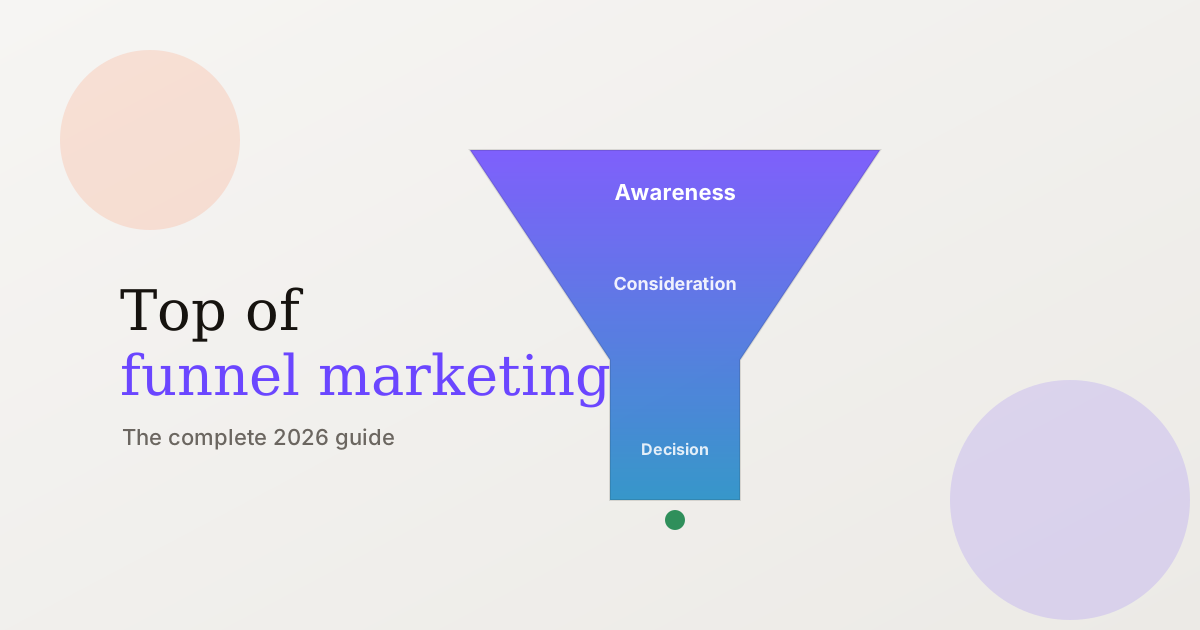
The marketing funnel is the path a potential customer walks through, and it has three core stages, each with a different job.
- Top of funnel (awareness): people discover your brand and explore a problem. Your job is to educate, not sell.
- Middle of funnel (consideration): people compare solutions. Your job is to show why yours fits.
- Bottom of funnel (decision): people are ready to buy. Your job is to make the decision easy.
Most marketers spend the majority of their budget at the bottom, because that is where revenue shows up. But 96% of website visitors are not ready to buy when they first land on your site (Outbrain, 2025 Full-Funnel Report). If you only create content for the 4% who are ready, you ignore everyone else.
TOFU vs MOFU vs BOFU, side by side
- TOFU (awareness): the buyer thinks "I have a problem." Goal: educate and attract. Content: blog posts, videos, social, guides. Key metrics: traffic, reach, impressions. Selling intensity: none.
- MOFU (consideration): the buyer thinks "what solutions exist?" Goal: nurture and compare. Content: product comparisons, case studies, webinars. Key metrics: engagement, email signups, MQLs. Selling intensity: soft.
- BOFU (decision): the buyer thinks "which one should I pick?" Goal: convert and close. Content: free trials, demos, pricing pages. Key metrics: conversion rate, revenue, CAC. Selling intensity: direct.
What are the 5 stages of the marketing funnel?
Some marketers use five stages instead of three: Awareness (the brand or category becomes known), Interest (the person engages with your content), Consideration (they evaluate fit), Intent (they show buying signals like a demo request), and Purchase (they become a customer). In this model, top of funnel marketing covers the Awareness and Interest stages.
Why TOFU is a system, not just a stage
In 2026, TOFU is not just the top of a neat pyramid. It is a system of discoverability, trust building, and signal creation that feeds everything else. Buyer journeys are messy now. Someone might see your LinkedIn post on Monday, read your blog on Wednesday, ask ChatGPT about your category on Friday, forget about you for three months, then see your name in an AI-generated answer and finally visit your pricing page. Top of funnel marketing is the reason they recognized your name at all.
Why does top of funnel marketing matter in 2026?
Top of funnel marketing matters more than ever in 2026 because most buyers are not in-market, AI is reshaping discovery, and awareness compounds. Three realities make the case.
Reality 1: 95% of your future customers are not ready to buy right now
Research from the Ehrenberg-Bass Institute and the LinkedIn B2B Institute established what marketers call the 95:5 rule (Marketing Week; LinkedIn B2B Institute): at any given time, roughly 95% of B2B buyers are out of market, and only about 5% are in a buying cycle. If your marketing only targets the ready 5%, you ignore the 95% who represent your future revenue, while competitors who invest in TOFU build trust with them.
Reality 2: AI search is changing how people discover brands
AI search engines like ChatGPT, Google Gemini, and Perplexity now handle a growing share of top-of-funnel queries. Google AI Overviews appear in an estimated 13% to 25% of all search queries (Contently, 2026), and that keeps rising. Gartner predicted traditional search volume could drop 25% by 2026 as AI chatbots take over discovery (Search Engine Land). Your TOFU content now needs to be optimized not only for Google's algorithm but for AI engines that summarize and cite. If your content is vague or missing specific data, AI tools will not cite it, and a growing portion of your audience will never find you. The fix is Answer Engine Optimization, covered below.
Reality 3: Brand awareness compounds over time
TOFU is a compounding investment, not a quick win. Brands that run a full-funnel strategy see roughly 45% higher ROI than brands focused on a single funnel stage (multiple industry benchmarks). Every touchpoint builds recognition, which lowers CAC and lifts conversion rates at every later stage. Tellingly, 67% of B2B content teams prioritize top-of-funnel content above all other stages (Content Marketing Institute), because the long-term data shows consistent TOFU investment makes everything else work better.
Top of funnel vs bottom of funnel marketing
The difference comes down to demand: bottom of funnel captures existing demand, while top of funnel creates future demand. Both matter, but they do different jobs.
- Objective: TOFU builds awareness and trust. BOFU drives conversions and revenue.
- Audience: TOFU is broad and problem-aware. BOFU is narrow and solution-aware.
- Content: TOFU is educational. BOFU is product-specific and transactional.
- Timeline: TOFU pays off long-term (3 to 12+ months). BOFU pays off in days to weeks.
- Metrics: TOFU is measured by traffic, reach, and brand recall. BOFU by revenue, conversion rate, and CAC.
- ROI horizon: TOFU is 6 to 18 months. BOFU is immediate to 30 days.
If you only invest in BOFU, you eventually exhaust the current pool of in-market buyers, which is exactly what happened to me in 2022. If you only invest in TOFU, you build a big audience but struggle to convert it. You need both. A practical split: early-stage companies with tight budgets should start with BOFU to capture existing demand, then layer in TOFU as the business stabilizes. Established brands usually do best with a 60/40 or 70/30 split between TOFU and BOFU.
10 best top of funnel marketing tactics for 2026
1. SEO-driven content marketing
Publishing educational content that answers what your audience is already searching for is still one of the highest-ROI TOFU tactics. SEO content is durable: a well-optimized post can bring in traffic for years, unlike paid ads that stop the moment you pause them.
Focus on informational-intent queries: how-to articles, beginner guides, trend analysis, checklists. If you sell email software, write "how to grow an email list from zero," not "buy our tool." Apply the 80/20 rule: 80% of your content educates, only 20% mentions your product. The data supports the channel, as 77% of internet users still actively read blogs (HubSpot), and 73% of B2B and 70% of B2C marketers use content marketing (Content Marketing Institute). Structure every piece with clear H2 and H3 headings, concise answer-first opening paragraphs, and specific data with named sources, so it ranks in Google and is easy for AI tools to cite. Ahrefs has deep, practical playbooks on the SEO side of this.
2. Answer Engine Optimization (AEO)
Answer Engine Optimization (AEO) is the practice of structuring content so AI search tools like ChatGPT, Perplexity, Google Gemini, and Microsoft Copilot can find, summarize, and cite it. Unlike traditional SEO, which targets a list of links, AEO earns citations and answer placements inside AI responses. This is the tactic most marketers are still ignoring, and one of the biggest TOFU opportunities of 2026.
It matters because AI is becoming a primary discovery channel: ChatGPT now has over 900 million weekly active users (Contently, 2026). Most companies have not optimized for AEO at all, so early movers gain a real advantage, much like SEO in 2010. To optimize: lead with clear, direct definitions in the first 100 words; use FAQ and HowTo schema markup; include specific statistics with named sources; create comparison tables and structured lists that AI can parse; and consider adding an llms.txt file, a plain-text map that tells AI crawlers what your site is about and which pages matter most. If you are weighing whether that last one is worth the effort, I broke down exactly what it does, how to build one, and where it sits in your AEO priority stack in my guide to what an llms.txt file is and whether you actually need it.
To track AI referral traffic in GA4, create a Free Form exploration, add "Landing page + query string" and "Source / medium" as dimensions and "Sessions" as the metric, then filter Source/medium with the regex (chatgpt|perplexity|claude|copilot|ai|notebook|gemini). This shows exactly which pages earn AI traffic and whether it is growing month over month.
3. Social media thought leadership
Social media is one of the most accessible TOFU channels, but it only works when you share valuable insights rather than promote your product. It puts your brand in front of people during everyday scrolling, and when your content teaches them something useful, they associate your brand with expertise.
Good TOFU social content includes industry commentary, original data, frameworks your audience can apply, and personal lessons. For B2B, LinkedIn is usually most effective; for consumer brands, Instagram, TikTok, and YouTube Shorts deliver broader reach. Founder-led content works especially well for startups, because people want to learn from people, not logos. Consistency is the whole game: posting once a month does nothing.
4. Educational video content
Video is one of the most effective TOFU formats, and the data backs it: videos get shared 12 times more than text and images combined (G2, 2024). It combines visual and audio information, which makes ideas easier to remember, and it builds personal connection.
The formats that work best are explainer videos, tutorials, short industry-insight clips, sub-60-second clips for TikTok and Reels and Shorts, and educational webinars. For B2B, YouTube and LinkedIn are strongest; for B2C, TikTok, Instagram, and YouTube Shorts. One rule: TOFU webinars must teach, not pitch. The moment a webinar becomes a sales demo, you lose the trust that makes TOFU work.
5. Lead magnets and gated content
Lead magnets are free resources offered in exchange for a contact detail, usually an email. They deliver immediate value and turn anonymous traffic into known contacts you can nurture. When the resource genuinely helps, the person starts trusting your brand before any sales conversation.
Effective lead magnets include guides, templates, checklists, calculators, benchmark reports, swipe files, and free email courses. The core principle: the resource has to solve a real problem. A 2-page checklist that saves three hours beats a 30-page ebook full of fluff. In 2026 the trend is toward lower-friction exchanges, so a hybrid approach often wins: keep most content ungated for awareness, and gate only your most comprehensive, high-value resources.
6. Podcasts and audio content
Podcasts are a powerful TOFU channel because of depth of engagement. A listener who spends 30 to 60 minutes with your episode builds a far stronger connection than someone who scans a blog post for 30 seconds, and listeners tend to return, giving you repeated touchpoints.
There are two approaches. Launch your own branded podcast on topics your audience cares about, publish on a regular schedule, and commit to at least 20 episodes before judging results. Or appear as a guest on existing podcasts, which is faster and cheaper because you borrow the host's audience and credibility. The guest route is more efficient short-term; the owned show is more sustainable long-term.
7. Affiliate and partner marketing at the top of funnel
Partnerships let you borrow established audiences instead of building one from scratch, and the trust transfers when a brand your audience already trusts mentions you. This is underused in B2B, where most affiliate programs only chase last-click BOFU conversions.
Use co-marketing campaigns (a joint report or webinar both brands promote), TOFU-level influencer collaborations focused on awareness rather than discount codes, guest content placements in publications your audience already reads, and inclusion in curated "best tools for X" roundups, which often rank well in both traditional and AI search.
8. Community building
Building a community around a shared interest, rather than around your product, is one of the most sustainable TOFU strategies, though it takes patience. Communities create long-term affinity and generate organic word-of-mouth as members recommend tools to each other.
This can take the form of a Slack, Discord, or forum, an industry newsletter, a meetup or user-group series, or an active presence in places your audience already gathers like Reddit and LinkedIn groups. The essential rule: the community has to deliver genuine value independent of your product. If it feels like a thinly disguised marketing channel, members disengage.
9. Paid advertising for awareness
Paid advertising is the fastest way to generate TOFU reach, but it needs realistic expectations because awareness ads are not built to convert on the spot. Paid lets you control who sees your brand and when, putting your message in front of thousands within hours.
The strongest 2026 platforms for awareness are Meta, Connected TV, YouTube, LinkedIn for B2B, TikTok for younger audiences, and programmatic display. Broad targeting often outperforms narrow targeting here, because the goal is reach. Dedicate roughly 20% to 30% of paid media budget to TOFU, and measure it differently: track reach, video completion rate, brand recall lift, and assisted conversions, not immediate sales.
10. Original research and data
Publishing unique data and proprietary research is one of the most effective ways to build TOFU awareness, especially in B2B, because it creates a citation magnet. Journalists, bloggers, other marketers, and increasingly AI models reference your data, generating backlinks and mentions that compound, and it positions you as a category authority.
Formats that work include annual industry reports, benchmark studies, survey results, trend forecasting from your own data, and shareable visualized data sets. The advantage in the age of AI search is especially strong: AI models prefer to cite unique, authoritative data that exists nowhere else. If ten posts say the same thing but yours has a proprietary data point, AI tools will cite yours.
How to create TOFU content that actually works
Strong TOFU content balances reach with depth and survives AI summarization. A few principles apply to every format.
Wide content vs deep content. Wide content (accessible articles, videos, social posts) is built for reach and discovery. Deep content (comprehensive guides, research reports) is built for relationship building. An effective strategy uses both: wide content brings people in, deep content gives them a reason to stay.
Content that survives AI summarization. Lead with clear, direct answers instead of burying your main point in paragraph five. Use a logical H2 and H3 hierarchy that maps to search intent. Include specific, citable data with named sources. Use comparison tables and structured lists. Write short, quotable sentences, because AI models prefer a crisp self-contained statement over a long winding one.
E-E-A-T signals. Google's E-E-A-T framework matters most for TOFU, because first impressions shape credibility. Show experience with first-person accounts of what worked and what did not. Show expertise by citing studies by name and year. Build authoritativeness through mentions and backlinks from respected publications. Demonstrate trustworthiness with third-party reviews and transparent methodology.
How to measure top of funnel marketing without using the wrong metrics
Measure TOFU with awareness and pipeline signals, never with bottom-of-funnel conversion KPIs. The most common mistake is judging a brand-awareness effort by Google Ads conversion math. TOFU creates lagging effects: a post published today might not produce a sales conversation for six months. Judge it on immediate conversions and you will wrongly conclude it does not work. Use two categories of metrics instead.
Steering metrics (real-time optimization): traffic volume and growth rate, reach and impressions, social engagement rate, new subscribers and lead-magnet downloads, CPL or CPM, and branded search volume growth.
Proof metrics (long-term impact): pipeline contribution from TOFU-sourced leads, assisted-conversion attribution, win rates among prospects who engaged with TOFU content versus those who did not, average deal size for TOFU-influenced deals, CAC trends over time, and brand recall survey results.
Cohort-based measurement is one of the most revealing approaches. Group prospects by the month they first engaged, then track how each cohort moves through the funnel. You might find that prospects who first discovered you through an educational post convert at a higher rate and larger deal size than those from a paid ad, but take three months longer to decide, an insight standard analytics would miss.
Incrementality testing is the gold standard if you have the budget. Pause all TOFU activity in one market or segment while keeping it running everywhere else, then measure the difference in leads, pipeline, and revenue over 60 to 90 days. A clear decline in the test market is hard evidence of TOFU's contribution that does not depend on any attribution model.
Top of funnel marketing by business type
TOFU strategy is not one-size-fits-all. The strongest channels shift by business model.
- B2B SaaS: SEO, thought leadership, webinars, and original research. Focus on problem-awareness and category education. Key metric: MQLs and branded search lift.
- E-commerce: SEO, social video, influencer partnerships, and user-generated content. Focus on lifestyle, inspiration, and product education. Key metric: traffic, email signups, social engagement.
- Local businesses: local SEO, educational social content, and community involvement. Focus on local expertise and how-to guides. Key metric: local search visibility and foot traffic.
- Professional services: SEO, webinars, guides, and email newsletters. Focus on expertise demonstration and case studies. Key metric: consultation requests and email-list growth.
- Startups: founder-led social content, partnerships, and community building. Focus on unique perspectives and category definition. Key metric: social following, community size, press mentions.
For startups with limited budgets, the most cost-efficient mix is usually founder-led social content, SEO-driven blog posts, and strategic partnership or guest content.
Common TOFU marketing mistakes (and how to fix them)
- Selling too early. Inserting product pitches into content that should be purely educational damages trust. Fix: keep TOFU content genuinely helpful and product-agnostic, and save sales messaging for MOFU and BOFU.
- Ignoring AI search optimization. Creating content only for traditional Google search misses the growing share of AI discovery. Fix: audit existing content for AI-readability, with key definitions in the first 100 words, a clear heading hierarchy, and citable data.
- Using BOFU metrics for TOFU. Judging blog content by direct conversion rate makes it look like a failure. Fix: set separate KPI frameworks per funnel stage and hold TOFU accountable for reach, engagement, and early pipeline signals.
- Inconsistent brand voice. Sounding clinical on the blog, playful on social, and corporate in email prevents the compounding effect of repeated impressions. Fix: define a brand voice guide and apply it everywhere.
- Not nurturing TOFU leads. Attracting visitors and then doing nothing wastes the work. Fix: build clear pathways from TOFU to MOFU.
How to move TOFU leads to the middle of the funnel
Move TOFU leads forward with nurture, retargeting, and content mapping, without being pushy. TOFU is only valuable if it feeds the rest of your funnel.
Email nurture sequences. When someone downloads a lead magnet or subscribes, use automated sequences that start with more educational content, then gradually introduce your product as one possible solution. The phrase "one possible" matters: make it feel like a helpful recommendation, not a pitch.
Retargeting campaigns. Serve ads to people who already engaged with your TOFU content, promoting MOFU pieces like case studies and comparisons. The sequence matters: first they saw your educational content, now they see content that introduces solutions.
Content mapping across funnel stages. Document a map that connects each TOFU piece to related MOFU and BOFU content. For example, a TOFU post on "how to manage a remote team effectively" links to a MOFU comparison guide on project management tools, which links to your BOFU pricing page. Readers feel like they are learning, and each piece naturally leads to the next.
The hand-raise moment. Some visitors will read one post and jump straight to pricing. Include prominent but non-intrusive CTAs, keep a clear path to product and pricing in your navigation, and offer chat or demo options, so people can move faster whenever they are ready without pressuring those who are not.
Key takeaways
- Top of funnel marketing attracts people at the very start of their journey. It educates and builds trust, it does not sell.
- 96% of visitors are not ready to buy on their first visit (Outbrain, 2025). TOFU keeps you visible until they are.
- The 95:5 rule means 95% of B2B buyers are out of market at any time. TOFU builds trust with that 95%.
- AI search is reshaping discovery. Optimizing for AI citations through AEO is a major 2026 opportunity.
- The 10 best tactics: SEO content, AEO, social thought leadership, video, lead magnets, podcasts, partner marketing, community, paid awareness, and original research.
- Measure with steering metrics (traffic, reach, engagement) and proof metrics (pipeline, CAC trends), not BOFU conversion math.
- Use the 80/20 rule: 80% educational, 20% product. And build clear TOFU-to-MOFU pathways.
FAQ
What is top of funnel marketing? Top of funnel marketing is the set of activities focused on building brand awareness and attracting potential customers at the earliest stage of their journey. It includes content marketing, social media, paid advertising, and SEO. The goal is to introduce your brand to people who may not yet know they need your product.
What is top and bottom funnel marketing? Top of funnel marketing focuses on awareness and discovery, targeting people new to your brand. Bottom of funnel marketing focuses on conversion, targeting people ready to buy. Top of funnel creates future demand, and bottom of funnel captures existing demand. Both are essential.
What is a TOF in marketing? TOF (also written TOFU) stands for "top of funnel." It refers to the awareness stage of the customer journey, where potential buyers first encounter your brand. Activities at this stage are designed to educate and attract, not to sell directly.
What are the 5 stages of the marketing funnel? The five stages are Awareness, Interest, Consideration, Intent, and Purchase. Top of funnel covers the Awareness and Interest stages, where prospects discover your brand and begin engaging with your content.
How do you elevate your marketing with top of funnel approaches? You elevate it by investing in activities that build long-term awareness and trust: educational content optimized for both search engines and AI visibility, community building, social thought leadership, and awareness-focused paid campaigns. The key is measuring TOFU with appropriate metrics like reach and branded search lift, not immediate conversions.
What is the difference between top of funnel and bottom of funnel tactics? Top of funnel tactics attract new audiences and build awareness: blog posts, social content, educational videos, and lead magnets. Bottom of funnel tactics convert interested prospects: demos, free trials, pricing pages, and case studies. The difference is intent: TOFU targets people exploring, BOFU targets people ready to decide.